


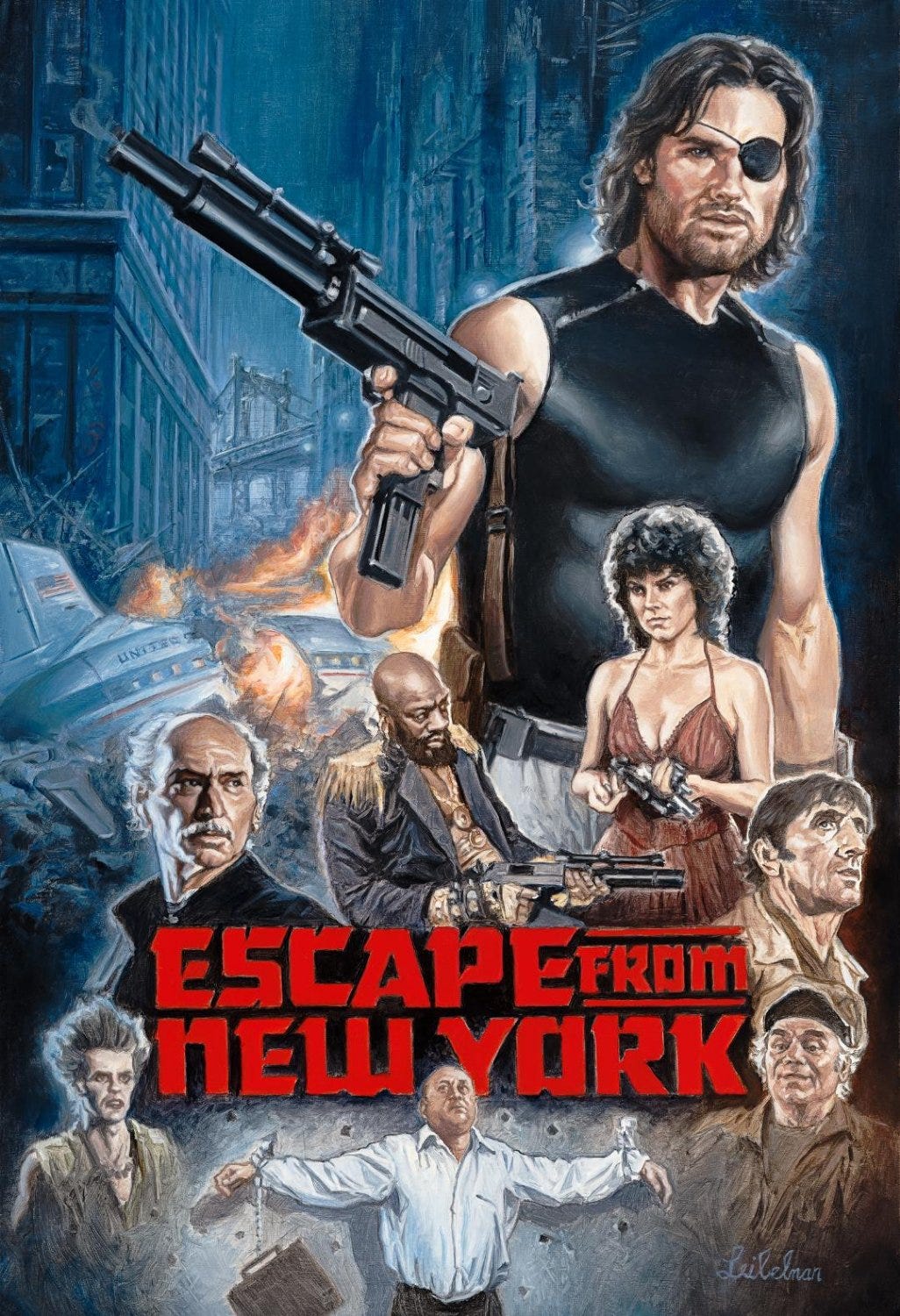
In a near-future New York, an über-socialist mayor rises to power, pledging to dismantle capitalism and replace it with a system of fairness and equality. Campaign posters glow with the promise of a new social contract — a city run by compassion, not control.
Frederick R. Smith

Words 766 | Read Time 3 min | Enjoy
Note: This is a work of fiction. Yet behind the story lies a cautionary warning — what happens when political idealism runs unchecked, and the systems that sustain society collapse under the weight of their own promises.
Epigraph
“Every progressive revolution ends by eating its own.”
— Unknown, recovered from the ruins of City Hall
Prologue: The Fall of Manhattan
When Escape from New York hit theaters in 1981, it wasn’t just science fiction — it was prophecy.
John Carpenter’s grim vision of Manhattan, walled off and turned into a maximum-security prison, captured a nation’s unease. Crime was rising, institutions were faltering, and trust in government was evaporating. Carpenter asked a simple, chilling question: What happens when society gives up trying to fix itself — and locks the problem away?
At the center was Snake Plissken, the cynical antihero forced to navigate the ruins of a once-great city. Beneath the action, Carpenter’s film was a meditation on decay — not just of infrastructure, but of faith in civilization itself.
Now, decades later, the question reverses:
What if society didn’t collapse from brutality — but from idealism taken too far?
What if the pursuit of perfect equality became the seed of its own destruction?
That’s where the sequel begins.
The Promise of Utopia
In a near-future New York, an über-socialist mayor rises to power, pledging to dismantle capitalism and replace it with a system of fairness and equality. Campaign posters glow with the promise of a new social contract — a city run by compassion, not control.
Policing is disbanded and replaced with “community councils.” Property laws are rewritten to ensure “equal access.” The mayor’s first act is to declare the economy “a public good.”
The Illusion of Prosperity
At first, the changes seem promising. Money floods the streets, but nothing holds value. The city’s treasury keeps borrowing—and promising—until the bills buy less each week. A loaf of bread costs what rent used to.
Those who can leave, do—those who can’t barter and scavenge.
It’s a mirror of Weimar Germany’s hyperinflation, when prices doubled every few days and children played with stacks of near-worthless marks. Economist Constantino Bresciani-Turroni called it “a collective illusion of prosperity” — a society drunk on paper wealth until the hangover came.
The Breakdown of Order
Without police, chaos fills the vacuum. “Community patrols” morph into local gangs. Justice becomes territorial. Every neighborhood has its own rules, its own little fiefdom.
The mayor still speaks of equality, but no one listens — not when survival depends on whose street you sleep on.
The Collapse of Civilization
The city becomes its own island, self-contained and self-devouring. Inflation, scarcity, and fear build invisible walls more impenetrable than any prison. People can leave, but few do. What lies beyond is just another failure wearing different colors.
The collapse echoes Hannah Arendt’s warning that when order dissolves, “individuals become superfluous” — not because they are oppressed, but because there’s no longer a structure that connects them.
The Final Fade
In the end, the city doesn’t explode. It just fades.
Stores boarded up. Transit silenced. Government offices are dark.
A place that wanted to set people free has trapped them instead — not behind walls, but behind chaos.
If John Carpenter were alive to direct the sequel, he wouldn’t need to change much. He’d swap the prison jumpsuits for protest banners and call it what it is:
Escape from Utopia.
Sources for Further Reading
Stanford Encyclopedia of Philosophy: Hannah Arendt
History Channel: Weimar Republic
About This Story
The City That Ate Itself is a speculative sequel concept inspired by John Carpenter’s 1981 classic Escape from New York.
It imagines a world where civilization collapses not from tyranny, but from the slow decay of unchecked idealism — a society that tried to perfect itself, and in doing so, consumed itself instead.


I warmly encourage you to consider becoming a paid subscriber if you have the means. Tips are appreciated, too. Regardless of your choice, your support is deeply appreciated. From the bottom of my heart, thank you for your invaluable support!
Excellent article.
Isn't that what's called Predictive Programming?