


Nothing is more calculated to make a demagogue popular than a constantly reiterated demand for heavy taxes on the rich. Capital levies and high income taxes on the larger incomes are extraordinarily popular with the masses, who do not have to pay them.
— Ludwig von Mises

Words 2,857 | Read Time 13 min | Enjoy
The Rhetoric and Its Irony
Few political slogans in modern American life carry more populist energy than “tax the rich.” Chanted at rallies, stitched onto designer gowns at the Met Gala, and repeated from the floors of Congress, the phrase projects the image of raunchy righteous leaders standing with the downtrodden against rapacious plutocrats. There is just one persistent problem: a remarkable number of the politicians most loudly championing this cause are themselves very wealthy — in some cases, extraordinarily so. They occupy, by almost any definition, the very class they propose to tax. This gap between proclamation and personal circumstance is not a minor footnote; it is the central irony of American progressive politics.
A Gallery of Comfortable Crusaders
The wealth of leading progressive politicians is a matter of public record, reported annually in financial disclosures required by federal law. The figures reveal a governing class whose material comfort sits in striking contrast to the working-class constituencies they claim to champion.
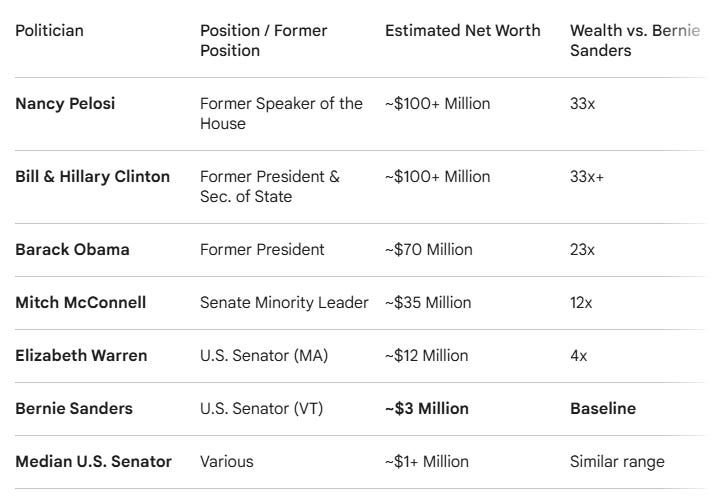
Nancy Pelosi stands at or near the top of any honest accounting. Former Speaker Nancy Pelosi and her husband have a net worth estimated at over $100 million — though some estimates range considerably higher. A viral post in early 2025 put Pelosi’s net worth at $202 million, and while the exact figure is disputed, experts acknowledge that her wealth is in that range. Her fortune derives largely from her husband Paul Pelosi’s investment activities — activities that have themselves generated controversy, since they occur in sectors directly affected by legislation Pelosi has overseen. Throughout her career, Pelosi has been a consistent voice for taxing the wealthy at higher rates, a position she holds while managing one of the largest personal fortunes in congressional history.1
Al Gore, a former Vice President and the most prominent political face of climate activism for two decades, has parlayed public service and ideological advocacy into a personal fortune. Al Gore is a former senator, Vice President, environmental activist, and entrepreneur who has a net worth of $300 million. Gore left the White House in 2001 with a net worth that was modest by Washington standards. His fortune was built after office through investments in green technology, the sale of his Current TV cable network to Al Jazeera for a reported $500 million, and speaking fees. He has consistently argued that the wealthy must bear a larger share of the tax burden.2
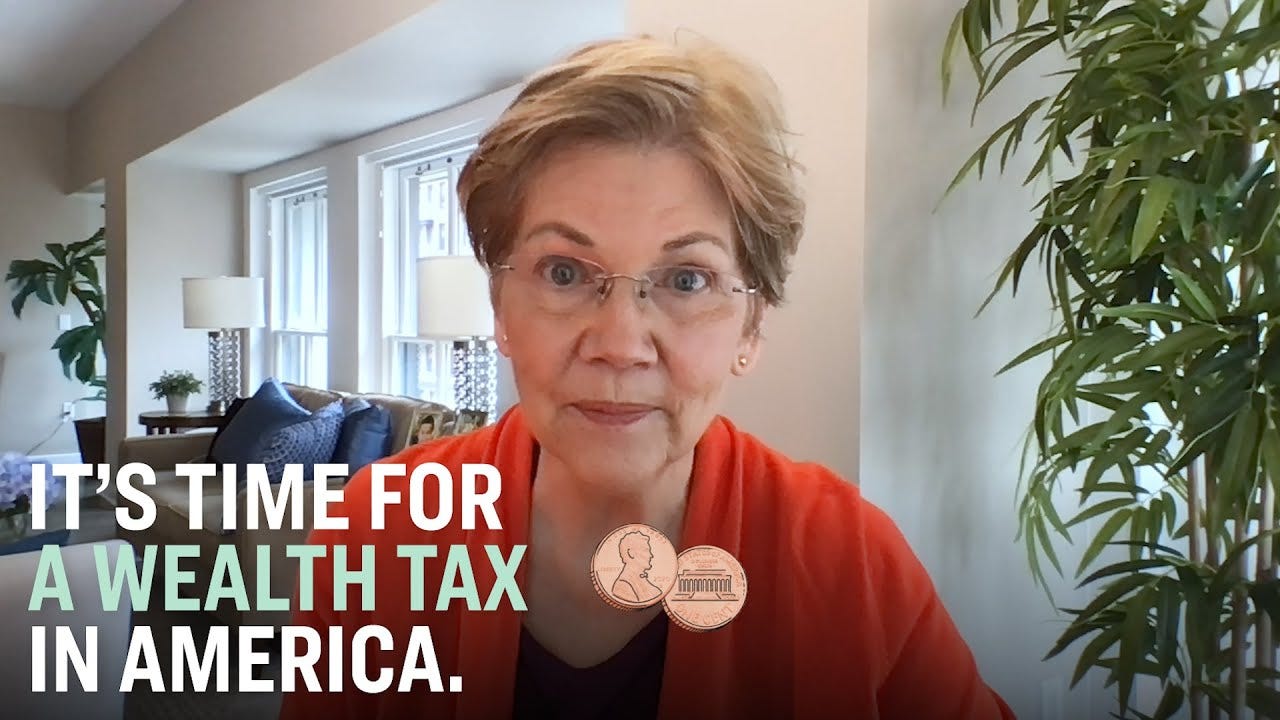
Elizabeth Warren, the Massachusetts senator whose academic career focused on economic inequality and whose presidential campaign made the wealth tax its centerpiece, is herself a millionaire. Elizabeth Warren, another progressive voice, is worth approximately $12 million. Warren’s “Ultra-Millionaire Tax Act” would impose a 2 percent annual tax on wealth above $50 million and an additional 1 percent above $1 billion. She has framed the debate in the starkest moral terms, declaring that “a secretary shouldn’t pay a higher tax rate than the CEO” and that “the current tax code is rigged against working people.” Warren’s wealth, accumulated through years of academic salaries, book advances, and investments, places her solidly in the top few percent of American households, though she falls well short of her own proposed threshold.3
Bernie Sanders, the senator from Vermont who made democratic socialism a mainstream conversation piece and whose rallying cry of class warfare electrified millions of younger voters, is himself a millionaire. By 2025, Bernie Sanders’ net worth is approximately $3 million. For a couple in their 80s who’ve both worked professional jobs for most of their lives, this isn’t exactly yacht money — it’s more like ‘comfortable retirement with a couple of vacation homes’ money. That characterization is telling in itself: the possessor of multiple vacation homes, decrying the decadence of the ownership class. Sanders’ wealth grew significantly after his 2016 presidential run, largely from three book deals that earned him more than $1 million. He has long called for a tax on extreme wealth, publishing detailed proposals on his Senate website to tax the net worth of the top 0.1 percent and reduce extreme inequality.4
Chuck Schumer, the Senate Minority Leader and one of the most powerful Democrats in Washington, is also comfortably wealthy. One widely circulated 2025 estimate put Schumer’s net worth at $75 million, though independent analysts pegged the figure lower based on actual disclosures. Whatever the precise number, Schumer’s accumulated wealth places him squarely among the upper class of Americans he routinely campaigns against.5
Gavin Newsom, the California governor often discussed as a future presidential contender and a champion of high-tax, high-spending progressive governance, has a net worth estimated at around $30 million as of 2025, reflecting a mix of political salaries, entrepreneurial ventures, and investments. His annual salary as governor was increased to $291,715 in 2025, making him the highest-paid governor in the United States. Newsom governs the highest-income-taxed state in the nation, one that has seen significant outmigration of wealthy residents to lower-tax states — even as he presses for ever-higher levies on the rich.6
Barack Obama left the presidency with a modest fortune, but post-office prosperity transformed his financial status. Barack Obama’s net worth is estimated at around $70 million, largely from book deals after leaving office. Obama was a consistent advocate for higher taxes on high earners during his presidency, famously invoking Warren Buffett’s argument that the billionaire paid a lower effective tax rate than his secretary.7
The pattern across this mystic menagerie is consistent: politicians who have made “tax the rich” a defining cause are, by virtually any reasonable standard, themselves rich — drawing salaries multiple times the median American wage, with members of Congress earning $174,000 per annum as of 2025, almost three times the average U.S. income of around $63,600 — and accumulating net worths ranging from the comfortable millions to the spectacular hundreds of millions.8
The Grand Promise That Never Arrives
If the first irony is that the advocates of taxing the rich are themselves rich, the second is perhaps more damaging: the policy never actually gets enacted.
The public has supported raising taxes on the ultrarich and corporations for years, but policymakers have not responded. Small increases in taxes on the rich that were enacted during Democratic control of Congress and the White House have been consistently swamped by larger tax cuts enacted during Republican control.9
This is not due to a lack of formal proposals. Warren and Sanders have introduced wealth tax legislation in multiple congressional sessions. As recently as March 2026, lawmakers renewed a push for Warren and Rep. Jayapal’s Ultra-Millionaire Tax Act, with 45-plus co-sponsors, envisioning massive investments in affordable housing, universal childcare, expanded Medicare eligibility, and tuition-free community college. The bill has approximately zero chance of becoming law, and every legislator signing on to it knows it. The proposal serves a rhetorical function: it signals solidarity with working people, energizes a progressive base, and generates fundraising — all without requiring anyone to actually do the difficult political work of coalition-building to pass legislation.10
The gap between promise and performance is a bipartisan fixture of American political life, but it is particularly acute on the left’s signature wealth-tax agenda. When Democrats controlled both chambers of Congress and the White House from 2021 to 2023 — their best legislative window in a generation — the wealth tax died without a floor vote in either chamber. The bulky-BS Build Back Better framework, despite enormous initial ambition, was whittled down repeatedly under pressure from within the Democratic caucus itself, from senators like Joe Manchin and Kyrsten Sinema who represented states and donor classes with direct financial stakes in the outcome.
Why Implementation Fails: The Structural Explanation
The failure of wealth taxation is not simply a matter of political cowardice, though there is some of that, too. There are genuine structural forces at work.
The wealth tax proposed by Senator Warren arrives wrapped in a promise that feels almost effortless: tax the rich just a little bit more, and suddenly the country can afford everything it has been told it cannot. But wealth is not idle — it is capital in motion, financing businesses, underwriting risk, driving innovation, and fueling the productivity gains that raise living standards across an entire society. When the government systematically extracts that capital, it does not simply rebalance outcomes; it redirects resources away from productive investment into political allocation.11
International experience supports the caution. President Emmanuel Macron, no conservative, abolished France’s wealth tax in 2017 after concluding it was damaging France’s economy without meaningfully reducing inequality. The promise of the tax had been redistribution; the reality was capital flight. In California, even the proposal of a wealth tax referendum triggered capital flight, with high-profile figures such as Google co-founders Larry Page and Sergey Brin, Peter Thiel, and Steven Spielberg relocating or shifting their residency. One Stanford-Hoover analysis estimated that just six such departures removed roughly $536 billion from the proposed tax base — nearly one-third of the wealth the tax was supposed to target. The tax had not even passed, yet the erosion had already begun.12
There is also the matter of who funds political campaigns. US politicians are “more dependent on the largesse of the billionaire class than ever before, giving one-four-hundredth of 1% of Americans extraordinary influence over which politicians and policies succeed.” Senators and representatives who denounce billionaires from the podium are often, the same week, attending fundraisers hosted by them. The donors who fund Democratic campaigns have their own tax attorneys and their own thresholds of tolerance for redistribution. The convergence of political incentives and donor interests creates a structural bias toward rhetoric over action.13
The Psychology of the Comfortable Reformer
There is a long tradition of wealthy reformers in American history — FDR, a Hudson Valley patrician, enacted the New Deal; the Kennedys, scions of enormous fortune, championed civil rights and anti-poverty programs. The rich advocating for taxes on the rich is not inherently cynical; sometimes it reflects genuine conviction.
But there is a difference between conviction and performance. When the same proposals are advanced decade after decade, session after session, with the full knowledge that they will not pass — and when the proposers themselves take careful advantage of every tax benefit available to their own wealth — the performance quality of the exercise becomes harder to ignore. The public is deeply distrustful of policymakers and doesn’t believe they will ever put typical families’ interests ahead of those of the rich and powerful. In tax policy debates, this means people are often highly skeptical of any proposed tax increase, even when told it will affect only the very rich.14
That skepticism is earned. The bumper sticker says “tax the rich.” The financial disclosure says the speaker is rich. The legislative calendar confirms no such tax will pass. The cycle repeats: the next election, the same politicians, the same speeches, the same unfulfilled promise.
Conclusion
“Tax the rich” is one of the most durable and politically potent slogans in American progressive politics. It captures a real grievance — wealth concentration in the United States is historically severe, and the tax code does offer significant advantages to those with capital over those who work for wages. These are legitimate concerns deserving serious policy attention.
But the crusade against wealth inequality has become, in practice, a comfortable identity for comfortable people. The politicians who invoke it most passionately — worth tens of millions of dollars, drawing six-figure salaries, attending fundraisers with the very billionaires they campaign against — have had ample opportunity to act and have not. The wealth tax bills accumulate co-sponsors, generate press releases, and die in committee. The net worths of their sponsors continue to grow.
A political movement sincere about taxing the rich might start with something unfamiliar in Washington: a degree of personal accountability, and a reckoning with the distance between the podium and the portfolio.
Parting Shot: The Miseducated Mind and the Daily Dose of Gaslighting
Perhaps the most underappreciated dimension of this entire spectacle is not the hypocrisy of the wealthy politician, nor the structural futility of legislation designed to fail. It is the stunning effectiveness of the con on the people it purports to help.
Consider the machinery required to sustain it. A senator worth tens of millions of dollars steps to a microphone and declares himself the champion of the working poor. A former Vice President, worth $300 million, jets between climate conferences on private aircraft while demanding that ordinary Americans bear the costs of the green energy transition. A Speaker of the House, presiding over a fortune that would take the average American worker several lifetimes to accumulate, rails against the greed of the ownership class. And the audience — burdened by student debt, squeezed by rent, watching their savings erode against inflation — applauds. They donate. They canvass. They vote.
This is not politics. It is a masterclass in gaslighting, executed at an industrial scale.
Gaslighting, in its clinical sense, is the manipulation of a person into doubting their own perception of reality. In its political form, it works like this: the very conditions that make people miserable — stagnant wages, unaffordable housing, a tax code riddled with loopholes for the connected — are perpetuated by the people who campaign most loudly against them. The voter who feels the system is rigged is told, year after year, that it is indeed rigged, that rescue is coming, that this election is the one that will finally change things. The rescue never comes. The system remains rigged. The politicians grow richer. And the cycle begins again, with fresh urgency and a new villain conveniently identified just in time for the next fundraising quarter.
The vulnerability that makes this possible is not stupidity. The people drawn to the “tax the rich” banner are often thoughtful, frustrated, and entirely correct that wealth inequality is a genuine and serious problem. Their vulnerability is something more insidious: miseducation. Decades of declining civic instruction have produced a citizenry increasingly unable to distinguish between a politician who holds a position and one who intends to act on it — between a press release and a law, between a co-sponsor list and a policy outcome. When you have never been taught how a bill actually becomes law, how campaign finance actually works, or how to read a financial disclosure form, you are left with nothing but the speech — and the speech is very good indeed.
The miseducated American mind does not know what questions to ask. It does not know to ask why the wealth tax bill introduced in seventeen consecutive sessions has never received a floor vote. It does not know to ask why the politicians who campaign on taxing unrealized capital gains do not voluntarily pay taxes on their own unrealized capital gains. It does not know how to ask who funded the senator now weeping for the working class. It hears the passion, feels the solidarity, and fills in the rest with hope.
Hope, under these conditions, is not a virtue. It is a vulnerability — one that a certain class of political professional has learned to monetize with extraordinary precision.
The antidote is not cynicism. Cynicism is simply despair wearing a trench coat, and it serves the grifter just as well as credulity does — the cynic who refuses to engage is no threat to anyone. The antidote is a colder, harder, more demanding form of attention: one that measures politicians not by the fervor of their rhetoric but by the content of their financial disclosures, the fate of their legislative priorities, and the distance between what they say in October and what they do in January.
Until that attention becomes widespread, the creepy crummy mantra will continue. The rallies will fill. The donations will flow. The bills will die in committee. And the comfortable champions of the uncomfortable will return home to their vacation properties, satisfied that another cycle of democratic theater has been successfully staged — and that the audience, as always, never asked for a refund.📕

I warmly encourage you to consider becoming a paid subscriber if you have the means. Tips are appreciated, too. Regardless of your choice, your support is deeply appreciated. From the bottom of my heart, thank you for your invaluable support!
Cynicism and acceptance of human weakness has kept me from madness. I will become a cheery Charlie when our elected representatives vote to accept no pay while the government is shut down and when they vote for term limits.
Why can Warren Buffett get by with paying less taxes than his secretary? It's because of our unnecessarily confusing and cumbersome tax code. More than half of Americans pay no taxes and, as expected, have no allegiance or feeling of involvement in it. A flat-tax could be gradually adopted and then everyone would share in the success of failure of our society.
Thank you again and again for your facts and reality.
There are many false prophets, antichrist spirits in this wicked world system, especially prominent in the USA mid-term elections season.
1 John 4:1
Dearly beloved, believe not every spirit, but try the spirits if they be of God: because many false prophets are gone out into the world.
https://biblehub.com/catholic/1_john/4-1.htm
and
https://drbo.org/chapter/69004.htm
_____
1 John 2:18
Little children, it is the last hour; and as you have heard that Antichrist cometh, even now there are become many Antichrists: whereby we know that it is the last hour.
https://biblehub.com/1_john/2-18.htm